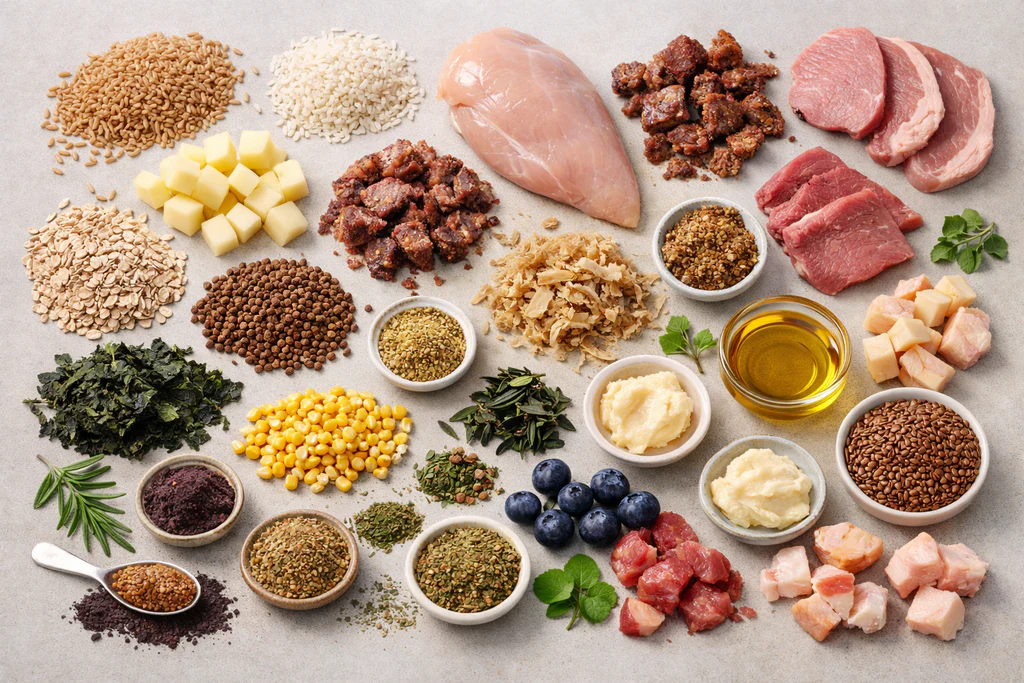
You turn the bag around and start reading.
Chicken. Rice. Oatmeal. Beet pulp. Fish oil. Chicory root.
Some ingredients sound gentle. Others sound unfamiliar. Then you pick up another food marketed for sensitive digestion and find a completely different ingredient list.
So which ingredients are best for a dog with a sensitive stomach?
There is no universal list. One dog may eat chicken and rice for years without a problem, while another develops soft stool whenever chicken returns to the bowl. One dog does well with more fiber; another becomes gassy and starts passing larger, more frequent stools.
A better question is: what does this particular dog digest consistently?
Protein tolerance matters. So do fat level, fiber type, carbohydrate source, and the way a complete food brings them together. This guide will help you look past front-of-bag claims and match ingredient characteristics to the digestive pattern you actually see at home.
There Is No Single “Best” Ingredient for Every Sensitive Stomach
Imagine two dogs in the same kitchen. Max tends to have soft stool after rich meals. Lucy is usually fine until certain protein changes seem to bring digestive trouble back.
Both may be described as having sensitive stomachs. They do not necessarily need the same ingredients.
That is why “10 best ingredients” lists can mislead. Pumpkin may support stool quality in some situations, but more fiber is not automatically helpful. Rice may be easy to digest, yet a rice-based food can still be a poor fit if the overall fat level or protein source does not suit the dog.
The ingredient only makes sense in the context of the digestive pattern.
If you are still trying to decide whether recurring changes fit a broader pattern, our guide to signs of a sensitive stomach in dogs explains how stool changes, vomiting, gas, appetite, and feeding history can fit together.
Digestibility and tolerance are not the same thing
A highly digestible ingredient can generally be broken down and absorbed efficiently. That does not mean every dog will tolerate it well.
Chicken is a useful example. It can work perfectly well for many dogs, but calling it “easy to digest” does not resolve a repeated digestive pattern associated with chicken-containing diets.
The reverse mistake happens too. One episode of diarrhea does not prove an ingredient belongs on a permanent banned list. An abrupt food change, a rich treat, scavenging, overeating, stress, or an unrelated health problem can produce similar signs.
Repetition tells you more than reputation. Does the same pattern return with a particular food exposure? Does it improve when the diet becomes consistent? Or did several things change at once?
A repeated response also does not automatically tell you whether you are dealing with an allergy or an intolerance. Our guide to food allergy vs food intolerance in dogs explains that distinction in more detail.
Look for patterns before chasing “gentle” ingredients
When digestive trouble returns, it is tempting to add pumpkin, a probiotic, yogurt, a new protein—and then a different food because the stool is still soft three days later.
Soon, the bowl has changed so much that the original pattern is harder to see.
Instead, look at the main food, protein sources, treats, chews, table scraps, richness, and recent diet changes. If certain foods or feeding habits seem to make the problem worse, our guide to foods dogs with sensitive stomachs should avoid can help you reassess likely triggers without creating an unnecessarily long forbidden-food list.
For many dogs, protein is the most useful place to start.
Start With a Protein Your Dog Can Tolerate
Protein is often the first thing owners compare: chicken or salmon, turkey or lamb, perhaps duck because it sounds more specialized.
A better question is: which protein has this dog eaten consistently without the same digestive pattern returning?
Chicken, turkey, fish, and egg can all provide highly digestible animal protein in a well-formulated food. But digestible is not the same as universally tolerated.
If a dog repeatedly struggles on chicken-containing foods, another chicken formula is not automatically the right choice because chicken appears on an “easy-to-digest” list. At the same time, a dog doing well on chicken does not need duck or venison simply because those proteins sound more specialized.
Tolerance history matters. If your dog has eaten the same protein through long periods of normal stool, do not discard that information because another protein has a better marketing story.
A novel protein is only novel to your dog
A novel protein is generally one the individual dog has not eaten before, or has had little meaningful exposure to. Duck may be novel for one dog and completely familiar to another.
Check more than the main food. Treats, dental chews, flavored supplements, training rewards, and table scraps all contribute to protein exposure. A “lamb recipe” may also contain other animal-derived ingredients depending on the formulation.
Novel proteins can be useful in a structured dietary approach, but rotating through unusual meats is not a reliable way to diagnose a digestive problem. It can also make the dog’s exposure history harder to interpret if a veterinarian later recommends a controlled diet trial.
If you are choosing a complete commercial food, our guide to the best dog food for sensitive stomachs explains how protein choice fits with fat, fiber, food type, and overall formulation.
Hydrolyzed protein works differently
Hydrolyzed protein is not simply another choice beside chicken, salmon, or lamb. Hydrolysis breaks proteins into smaller components, and veterinary hydrolyzed diets use that approach for a specific nutritional purpose.
“Hydrolyzed” does not mean better for every sensitive stomach. A dog with occasional soft stool after a rich treat does not automatically need a therapeutic diet.
These diets may be used when a veterinarian is investigating or managing certain suspected food-related problems. The reason for using the diet and how strictly it is fed matter; flavored treats or chews can undermine a controlled trial.
For everyday ingredient selection, start with what your dog has already shown you. If a protein repeatedly appears around the same digestive pattern, document it rather than trying three new proteins in a month.
Choose Carbohydrates Based on How Your Dog Digests Them
Rice is gentle. Grains are bad. Sweet potatoes are better. Grain-free is easier to digest.
These shortcuts sound simple. A sensitive stomach rarely is.
Dogs can digest properly cooked starches, and carbohydrate ingredients can provide energy as part of a complete food. What matters is how the dog responds to the diet containing them.
Properly cooked rice can provide readily digestible starch, but rice alone does not make a food gentle. And chicken with white rice is not nutritionally equivalent to a complete long-term diet.
Brown rice brings a different fiber profile than white rice. Oats and barley contribute carbohydrate energy and fiber components. Potatoes and sweet potatoes can also work well for some dogs when used in a complete diet.
None is an automatic upgrade.
Sweet potato does not “heal the gut,” and a grain-free label does not predict digestive tolerance. If gas or stool changes begin after switching foods, compare the carbohydrate and fiber profile of the new formula with the old one.
Consistency is often more useful than finding the perfect carbohydrate. Ask which sources were present in foods your dog tolerated, what changed in the new formula, whether fat and fiber changed too, and whether you are feeding the same calories or simply the same number of cups.
The Right Fiber Can Help Normalize Stool
Fiber is one of the most misunderstood parts of a sensitive-stomach diet. Soft stool appears and the advice arrives almost immediately: add pumpkin. If that fails, add more pumpkin or find a high-fiber food.
Different fibers behave differently, and amount matters. The right profile may support more consistent stool. Too much—or the wrong match—can leave a dog gassy, uncomfortable, or passing much larger stools.
Soluble, insoluble, and fermentable fibers have different roles
Some soluble fibers interact with water and may be fermented by bacteria in the large intestine. Pumpkin is a familiar example, but it is not a universal stool fixer. Psyllium is a gel-forming fiber that can influence stool characteristics, yet it is not interchangeable with pumpkin—or something to keep increasing because the stool looks imperfect after one day.
Insoluble fiber contributes differently to bulk and movement through the gut. This is why “high fiber” does not tell you enough: two foods can have similar total fiber but use very different blends.
Beet pulp shows how easily ingredients get oversimplified. It is sometimes dismissed as filler and elsewhere praised as an ideal digestive ingredient. In reality, it is a functional fiber source used in many pet foods. Whether the complete formula suits a dog still depends on the formulation and the dog’s response.
Fermentable fibers can influence the gut microbial environment, but fermentation can also produce gas. If gas starts after a new food, supplement, or fiber addition, compare what changed rather than assuming the dog is “detoxing.”
More fiber is not always better
A dog switches to a digestive-support food. The stool is still a little soft on day two, so pumpkin is added. Then comes a probiotic-fiber supplement. Soon the dog is producing enormous stools four times a day and clearing the room with gas.
At that point, the problem may not be a lack of digestive support. There may simply be too much happening in the bowl.
Before adding fiber, consider what the complete food already contains. If you change the diet, watch stool consistency, frequency, straining, gas, and comfort.
The best fiber is the one that improves the pattern without creating a new problem. A dog with recurring soft stool may need a different fiber profile; a dog prone to gas may need closer attention to fermentable ingredients. If stool is already normal, there may be no reason to chase a higher-fiber formula at all.
Fat Level May Matter More Than the Fat Source
When loose stool follows a new food, the featured protein often takes the blame. Sometimes the more important change is that the new food is simply richer.
Compare foods rather than judging fat ingredients by name. Fish oil sounds healthier than chicken fat, but neither name tells you the total fat in the complete food. A food containing fish oil is not automatically low in fat, and one containing chicken fat is not automatically too rich.
Omega-3 fats such as EPA and DHA have distinct nutritional roles, but fish oil is not a sensitive-stomach cure. More oil will not correct a poorly matched protein, an abrupt food change, overfeeding, or every cause of diarrhea or vomiting. It also adds fat and calories.
The goal is not to find the lowest-fat food on the shelf. It is to notice whether richness belongs to your dog’s pattern and choose a complete diet accordingly.
Prebiotics and Probiotics Can Support the Gut—but They Are Not Magic Ingredients
Few phrases on a dog food bag sound as reassuring as “digestive support.” Add prebiotics or probiotics, and the food can seem like an obvious choice.
These ingredients can be useful parts of a well-formulated diet, but they do not erase everything else in the bowl. A food can contain probiotics and still be too rich, use a poorly tolerated protein, or simply not agree with the dog eating it.
Prebiotics feed microorganisms already in the gut
Ingredients such as chicory root, inulin, fructooligosaccharides (FOS), and mannan-oligosaccharides (MOS) may appear in digestive-support formulas. They are not identical, but some prebiotic fibers can influence the microbial environment in the gut.
Because fermentation can produce gas, “with prebiotics” does not predict how an individual dog’s stool or comfort will respond. The amount, fiber blend, and individual dog still matter.
Probiotics are more specific than “good bacteria”
Different microorganisms—and strains within a species—may have different characteristics. Amount, viability, formulation, and storage can matter too.
That is why “contains probiotics” is not enough to judge an entire food. When choosing a dedicated product, strain and formulation questions become even more important. Our guide to probiotics for dogs with sensitive stomachs explores those details.
Do not choose a food solely because probiotics appear on the package. A new food may also change fat, fiber, calorie density, and feeding amount. The probiotic claim does not cancel out those variables.
Be especially careful with the “more gut support is better” approach. A digestive-support food plus pumpkin, probiotic powder, yogurt, and a fiber chew can turn dinner into a nutrition experiment. If the dog improves—or becomes gassier—you may have no idea which change mattered.
Gut-supporting ingredients should support a food that already fits the dog. They are not a nutritional reset button.
A Shorter Ingredient List Is Not Automatically Better
Fewer ingredients can feel safer: fewer things to react to, fewer possible problems. But a shorter list does not tell you whether the food will be easier to digest.
Your dog’s stomach does not count ingredients. It responds to what they are, how much is present, and how the complete food is formulated.
Limited-ingredient diets can be useful when the goal is to simplify dietary variables. They are not universally gentle. A short list can still contain a poorly tolerated protein, be too rich for the dog, or use a fiber profile that increases gas.
The same caution applies to words such as clean, wholesome, natural, and premium. Familiar ingredients do not guarantee better digestibility. Technical names may simply reflect nutrients or functional components needed in a complete food.
A longer list is not proof of quality. A shorter one is not proof of better tolerance.
The best sensitive-stomach diet is the one whose ingredients, nutritional profile, and formulation fit the digestive pattern you have actually observed.
How to Match Ingredients to Your Dog’s Digestive Pattern
By this point, the ingredient list may feel crowded with suspects. You do not need to investigate all of them at once. Start with the pattern you can observe, then narrow the variables worth examining.
If soft stool keeps returning
Review the whole feeding picture. Did the protein change? Is the new food richer? What fiber sources are present? Are pumpkin, probiotics, chews, or supplements being added?
Recurring soft stool is not always a fiber shortage. Look for repeated associations: rich treats, a food switch that never stabilized, or several troublesome foods sharing a protein source.
If gas and bloating are the main problem
Look beyond protein to the fiber and carbohydrate profile, especially if gas increased after a food change. Then count the extras: chews, table scraps, yogurt, pumpkin, and supplements.
If gas began after several “gut-friendly” additions, simplifying the diet may tell you more than adding another ingredient.
Persistent abdominal swelling, obvious pain, repeated unproductive attempts to vomit, or sudden severe distress are different from ordinary flatulence and require urgent veterinary attention.
If vomiting seems to happen after meals
Vomiting after eating does not automatically identify a bad ingredient. Consider timing, meal size, eating speed, recent food changes, and whether rich foods are involved.
From an ingredient perspective, compare major protein and fat changes. But a dog that gulps a large meal may continue having problems after switching from chicken to salmon to lamb. Repeated vomiting should not be managed indefinitely through food experiments alone.
If the same protein keeps appearing when symptoms return
If a protein remains suspicious, stop rotating foods randomly and keep a clearer feeding record. Preserve useful information rather than introducing duck this week, venison next week, and rabbit the week after.
If the pattern seems unpredictable
Before testing more ingredients, simplify the record. Note the main food and amount, treats, chews, table scraps, stool changes, vomiting, gas, appetite, and unusual eating events.
A short daily note may reveal that “random” diarrhea follows weekend table scraps or that vomiting began when meal size increased.
If signs persist, become more frequent, or occur with weight loss, blood, significant lethargy, or appetite changes, the answer may not be hiding in the ingredient panel.
Change fewer variables and watch what happens
The most useful ingredient trial is one you can interpret.
If you change protein, fat, fiber, food format, treats, and probiotics on Monday, improvement by Friday will not tell you what helped. If the dog gets worse, you have the same problem.
Compare the old food with the new one. Identify the major nutritional changes. Feed an appropriate amount. Account for treats and extras. Then watch the dog over time.
Once you understand the pattern, the ingredient list becomes less intimidating. You are looking for a complete diet with a tolerated protein, a fiber profile that supports comfortable stool, and a fat level that fits the dog’s response—not every digestive buzzword in one bag.
The Best Ingredient Is the One Your Dog Consistently Tolerates
The search for sensitive-stomach ingredients often begins with a list: chicken, rice, pumpkin, salmon, sweet potato, probiotics.
But your dog does not eat an ingredient list. Your dog eats a complete diet.
The goal is not to build the most impressive bowl. It is to find a nutritionally complete diet your dog can eat, digest, and return to day after day without the same digestive trouble coming back.
Start with foods your dog has tolerated well. Pay attention to repeated patterns rather than one bad day. Change fewer variables at a time. Ingredients marketed as gentle, natural, limited, or gut-friendly still have to prove themselves in the dog standing in front of you.
The best ingredient is not the rarest protein or the newest digestive supplement. It is an appropriate ingredient, in a well-formulated diet, that your dog consistently tolerates.
And sometimes the most useful thing you can add to the bowl is not another ingredient at all.
It is consistency.